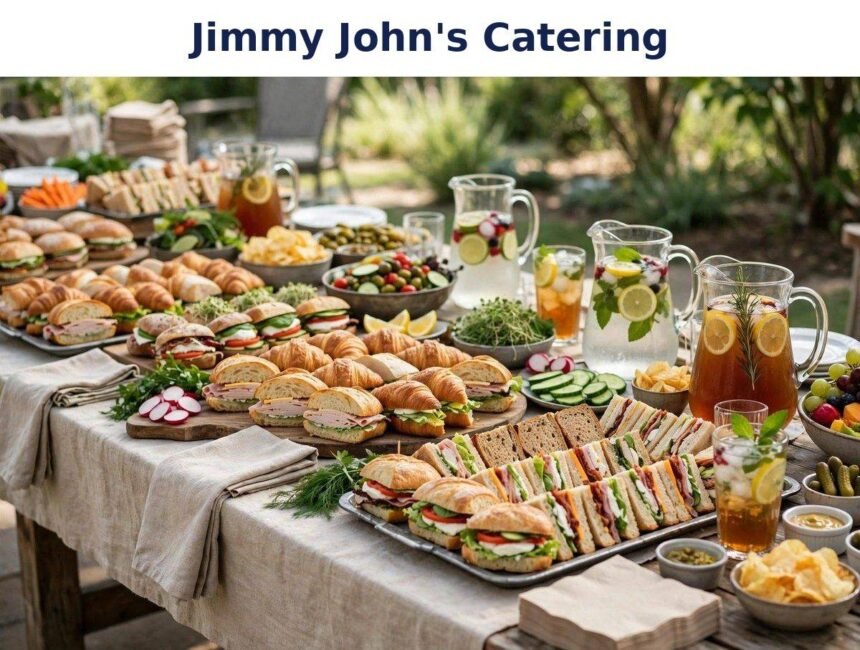
Planning food for a group is one of those jobs that looks simple until you are the person responsible for it. Everyone needs to eat, everyone has an opinion, and the food has to arrive on time, in enough quantity, and in a form that people can actually serve themselves without a lot of fuss. That is why so many event organisers start by searching for jimmy john’s catering. The idea is appealing on its face: a familiar sandwich brand, food that travels well, and a format that suits offices, parties, school events, and casual gatherings where a sit-down meal would be overkill.
This guide explains jimmy john’s catering in general terms: what it usually involves, who it tends to suit, how ordering typically works, and what to check before you place an order. Prices, minimum order amounts, delivery areas, and the current menu can change, and they can also vary by location, so this guide deliberately does not present them as fixed facts. Where a detail matters for your event, the safest step is to confirm it on the official ordering page or with the location that will fulfil your order.
What Jimmy John’s Catering Usually Means
At its simplest, catering from a sandwich shop means food prepared in larger quantities for a group, rather than a single order for one person. Instead of each guest ordering separately, one person places a combined order, and the food arrives in a shared format that makes serving straightforward. For jimmy john’s catering, that shared format is generally built around sandwiches and related party items, arranged so that guests can help themselves.
That format is part of the appeal. Sandwich catering does not need a kitchen at the venue, it does not need plates and cutlery in the same way a hot meal does, and it does not need someone to stand over a stove while guests arrive. The food can be set out on a table, guests can take what they like, and the host can focus on the event itself rather than on cooking and clearing up.
It is also a flexible format. A sandwich spread works for a working lunch, a birthday gathering, a team celebration, a study group, a community meeting, or a family get-together. It suits daytime events especially well, when people want something filling but not heavy, and when the schedule may not allow a long meal break. It is less suited to formal dinners or events where guests expect a plated, multi-course meal, and that distinction is worth keeping in mind when you choose.
Who Jimmy John’s Catering Tends to Suit
The best catering choice depends less on the brand and more on the shape of your event. Sandwich catering tends to work best when several of the following are true.
First, your guest list is a group rather than a handful of people, and you want one order to cover everyone. Second, your event is informal or semi-formal, and guests will be happy to serve themselves. Third, you have limited time or limited facilities at the venue, so food that arrives ready to serve is a real advantage. Fourth, your guests have varied tastes, so a spread with a range of options is more practical than a single dish that everyone must eat.
Offices are a classic example. A team lunch, a training day, a welcome event for new starters, or a farewell gathering all fit the pattern: people are together for a limited time, they need to eat without leaving the building, and the food should not disrupt the rest of the day. The same logic applies to school and college events, volunteer days, open houses, sports team gatherings, and casual celebrations at home.
That said, sandwich catering is not automatically right for every group. If several guests have serious dietary restrictions, you will need to plan carefully and confirm what options are available. If your event is outdoors in hot weather, you will need to think about how long food can safely sit out. If your guests expect a hot meal, a cold sandwich spread may feel like a letdown. The guide below helps you work through those questions before you commit.
How Ordering Typically Works
While the exact ordering flow can vary, catering orders from a sandwich brand generally follow a familiar pattern. Understanding that pattern in advance makes the process smoother, especially if you are ordering for the first time.
Step One: Decide on the Occasion and Headcount
Start with the basics: the date, the time, the venue, and a realistic headcount. A headcount that is roughly right is far more useful than a guess made in a hurry. If invitations are still going out, use the number of confirmed guests plus a sensible allowance for late confirmations, rather than the maximum number of people who might possibly attend. Your headcount drives the size of the order, the amount of serving space you need, and the delivery or pickup timing.
Step Two: Choose a Format That Fits the Event
Think about how people will eat. Will they sit at tables, stand and mingle, or eat at their desks between sessions? A format that works for a seated lunch may not work for a standing reception. Consider whether guests will eat all at once or graze over a longer period, and whether you need food that holds up well if the schedule runs late. These practical questions matter more than trying to pick the most impressive-sounding option.
Step Three: Check the Current Options for Your Location
Because menus and availability vary, the next step is to look at the official ordering page for the location that will serve your area. This is where you confirm what is currently offered, what the ordering requirements are, and whether delivery or pickup is available for your venue. Do this before you promise anything to guests or put details in an invitation, because an option you remember from another city or another year may not be on offer where you are.
Step Four: Place the Order With Clear Details
When you place the order, be precise. Give the correct date and time, the delivery address or pickup plan, a contact number for the day, and any notes about access to the building, parking, or where food should be left. If the venue has a service entrance, a lift booking, or a time window for deliveries, pass that information on at the time of ordering rather than on the day, when it may be too late to adjust.
Step Five: Plan the Setup Before the Food Arrives
Have tables, serving space, and any extras you need ready before the delivery window. Sandwich catering is at its best when guests can see the spread, move along it easily, and find drinks and napkins without asking. A little preparation here prevents the familiar scene of food arriving while the host is still clearing a table.
Planning Quantities Without Overordering
Quantity is the question every host worries about, and it is also the one with no single correct answer. Appetite varies by time of day, by the length of the event, by the age and activity level of the guests, and by whether other food will be available. A lunchtime event where sandwiches are the main meal calls for more generous planning than an afternoon gathering where sandwiches are one of several snacks.
A useful approach is to plan around your event rather than around a formula. Ask yourself: is this the main meal, or is it a supplement to other food? Will guests eat once, or will food be available over several hours? Are guests likely to arrive hungry after travel or activity, or will they have eaten recently? Will there be children present, and will their appetites differ from the adults? Answering those questions honestly gives you a better sense of scale than any generic rule.
It is also worth thinking about variety. Guests do not all want the same thing, and a spread that offers a mix of flavours and fillings tends to be received better than a large quantity of a single option. At the same time, too many choices can complicate serving and increase waste. A balanced approach — a reasonable range, with familiar options well represented — usually works best. If you know your group well, let that knowledge guide you: a team that always favours one style of sandwich will not suddenly change its tastes because it is a party.
Finally, plan for leftovers sensibly. Some hosts would rather have a little extra than run short, and that is understandable, especially when guests have travelled. Others prefer to order tightly to avoid waste. Either approach is valid, but decide which one you are taking before you order, and check the location’s policy on changes to an order, in case your headcount moves after you have placed it.
Delivery, Pickup, and Timing
How the food reaches you is a practical decision, not just a preference. Delivery suits events where the host cannot leave the venue, where the order is large, or where timing is tight. Pickup suits hosts who live or work near the location, who want to inspect the order before the event, or who are working to a budget where delivery fees matter. Neither option is inherently better; the right choice depends on your schedule, your transport, and your venue.
Timing deserves particular attention. Give yourself a buffer between the expected arrival time and the moment guests will eat. Traffic, building access, and setup all take longer than expected, and a buffer turns a small delay into a non-event rather than a crisis. If your event starts at midday, food arriving comfortably before midday is far less stressful than food arriving exactly on the hour while guests are already gathering.
For larger or more complex orders, ordering further in advance is sensible. It gives the location time to prepare, gives you time to correct any misunderstanding, and gives you a fallback if something needs to change. For smaller, simpler orders, a shorter lead time may be fine, but again, confirm the current requirement for your location rather than assuming it. If your event falls on a busy day, such as a public holiday or a major local event, earlier is almost always better.
Dietary Needs, Allergies, and Labelling
Dietary planning is where good hosts earn their reputation. Before you order, ask guests about allergies, intolerances, and dietary preferences, and take the answers seriously. A guest with a serious allergy needs clear information, not a guess. A guest who eats vegetarian, vegan, halal, kosher, or gluten-free food needs an option they can actually eat, not a plate of side items.
When you order, raise dietary needs explicitly and ask how items are labelled or separated. At the event, keep different options clearly identified, and avoid mixing serving utensils between dishes where cross-contact could be an issue. If you are unsure whether a particular item suits a guest’s needs, say so honestly and let the guest decide, or check with the location in advance.
This is also an area where the official ordering page and the fulfilling location are your best sources. Ingredients and preparation methods can change, and a general guide cannot guarantee the current composition of any item. For serious allergies, direct confirmation is not optional; it is essential.
Budgeting for Catering Without Fixed Prices
Because this guide does not quote prices, it is worth explaining how to think about budget instead. The total cost of a catering order is typically shaped by several factors: the number of guests, the format and quantity of food, delivery or pickup, and any extras such as drinks, sides, or serving supplies. A larger group, a more generous spread, and delivery to a distant venue will generally cost more than a smaller, simpler pickup order, but the exact relationship depends on the location and the current menu.
To budget sensibly, start with your headcount and your event format, then get a current quote for that specific order. Compare like with like if you are considering alternatives: an order that looks cheaper may include less food, fewer options, or no delivery, while an order that looks more expensive may cover drinks and supplies that you would otherwise buy separately. Ask what is included, what is extra, and what the payment and cancellation terms are, so there are no surprises.
It is also worth building a small contingency into your budget for extras you may have forgotten: drinks, ice, napkins, plates, or a tablecloth for the serving table. These small items are easy to overlook and surprisingly annoying to be without on the day.
Setting Up a Sandwich Spread That Works
A good setup makes food inviting and serving effortless. Start with a table large enough for the spread without crowding, positioned where guests can approach from at least one side without blocking a doorway or a walkway. Arrange items so that guests can see what is available, with any labels facing outward. Put drinks and napkins at the end of the line or on a separate table, so guests are not juggling a drink while they serve themselves.
Think about flow. If guests will all eat at once, a single line can create a queue; two serving points or a spread that guests can approach from both sides can ease that. If guests will graze, a central table that people can return to works well. Keep the serving area clean as the event goes on, clearing empty trays and tidying packaging, so latecomers are not faced with a messy table.
For outdoor events, shade and temperature matter. Keep food out of direct sun, and do not leave perishable food sitting out for longer than food safety guidance for your area allows. If the event will run for several hours, consider bringing food out in stages rather than putting everything out at once.
Common Mistakes to Avoid
Ordering Too Late or With a Vague Headcount
Late orders and uncertain numbers are the two most common sources of stress. Order as early as your plans allow, and update the location promptly if your headcount changes significantly.
Promising Specific Items Before Confirming Them
Do not put a specific item, price, or delivery promise in an invitation until you have confirmed it for your location and date. Guests remember promises, and a missing item is more noticeable than a slightly different spread.
Forgetting Drinks, Supplies, and Serving Space
Food is only part of the plan. Drinks, cups, napkins, plates, and a suitable table are all part of serving, and forgetting them can undermine an otherwise good order.
Ignoring Dietary Needs Until the Day
Ask early, plan explicitly, and label clearly. A guest who cannot eat anything on offer will remember the event for the wrong reason.
Leaving Food Safety to Chance
Keep perishable food at safe temperatures, respect time limits for food left out, and store leftovers promptly and properly if you plan to keep them.
Quick Planning Checklist
- Confirm the date, time, venue, and realistic headcount
- Decide whether sandwiches are the main meal or part of a larger spread
- Check the official ordering page for your location’s current options
- Confirm delivery or pickup, timing, and any fees or requirements
- Ask guests about allergies and dietary preferences in advance
- Plan drinks, napkins, plates, and serving space
- Allow a buffer between delivery and serving time
- Label dietary options clearly at the event
- Keep food at safe temperatures, especially outdoors
- Have a contact number ready for the day in case of a delay
Frequently Asked Questions
Does Jimmy John’s offer catering for groups?
Jimmy John’s is widely associated with sandwich catering for groups, and catering-style orders are commonly offered through its ordering channels. Availability, formats, and requirements can vary by location, so check the official ordering page for the location that will serve your event to confirm what is currently available.
How far in advance should I place a catering order?
There is no single answer that fits every location and order size. As a general rule, larger orders and busy dates benefit from earlier booking, while smaller orders may be possible at shorter notice. Confirm the current lead time for your location when you check the ordering page, and order as early as your plans allow.
Can I get delivery for a catering order?
Delivery and pickup options depend on the location and the delivery area for your venue. Some orders may be delivered, while others may need to be collected. Confirm this for your specific address before you finalise your plans, and provide clear delivery instructions at the time of ordering.
What should I do about guests with allergies or dietary restrictions?
Ask guests in advance, raise their needs explicitly when ordering, and confirm ingredients and labelling with the fulfilling location. At the event, label options clearly and keep serving separate where cross-contact could be an issue. For serious allergies, direct confirmation with the location is essential.
How do I know the current prices and minimums?
Prices, minimums, and menu items can change and can vary by location, so this guide does not quote them as current facts. Check the official ordering page or contact the location that will fulfil your order for the up-to-date details for your event.
Is sandwich catering suitable for a formal event?
It depends on the tone you want. Sandwich catering suits informal and semi-formal gatherings very well, and it can work for a relaxed corporate event or celebration. For a formal dinner where guests expect a plated meal, a different catering style is usually a better fit.
Conclusion
Jimmy john’s catering appeals for a straightforward reason: it turns feeding a group into a manageable task rather than a major project. Food that travels well, serves easily, and suits a wide range of tastes is a practical choice for offices, parties, school events, and casual gatherings, provided the format fits the occasion and the details are confirmed in advance.
The key to a smooth order is not a secret menu or a clever trick. It is early planning, a realistic headcount, a format that matches how your guests will eat, clear attention to dietary needs, and a quick check of the current options, prices, and requirements for your location on the official ordering page. Get those basics right, allow a buffer for delivery and setup, and the food becomes what it should be at any good event: present, plentiful, and quietly in the background while people enjoy themselves.
Read Also: Producertech: Complete Guide to Online Music Production Courses